
As an experienced professional, you will build on your expertise toward coaching mastery in the Center for Coaching Certification programs that support earning certification and credentials.
ICF-accredited Level 1 and Level 2 programs offer structured, rigorous coach training paths for experienced professionals to earn coaching certification online based on the ICF Core Competencies and Code of Ethics that are designed to support you earning an ICF credential. Level 1 prepares graduates to apply for the Associate Certified Coach, ACC, credential, while Level 2 prepares graduates for the Professional Certified Coach, PCC, credential, covering advanced methodologies.
Who benefits from coach training?
Because you already know how to develop people, professional training in coaching helps you develop the coaching mastery and professional credentials to match your experience. Coach training serves leaders, professionals, Human Resources professionals, talent development professionals, attorneys, financial planners, mental health professionals, medical professionals, consultants, and more. To explore the possibilities for you, schedule a no-obligation conversation to get the information you want to make choices: https://www.timetrade.com/book/BNHMN
For ICF coaching certification consider you options:
ICF Level 1 Coach Training Program (Overview) (Schedules)
- Purpose: Foundational training focusing on coaching competencies, ethics, processes, and coaching techniques.
- Requirements: Minimum of 60 hours of training covering the competencies and ethics and mentor coaching plus assessment and feedback for continued development.
- Outcome: Prepares graduates to do coaching and streamlines the application process for the ACC Credential.
- Best For: Professionals building on their expertise as a leader, experienced HR, talent development, and organizational development experts serving others in their organization.
ICF Level 2 Coach Training Program (Overview) (Schedules)
- Purpose: Comprehensive, advanced, and in-depth training suitable for deeper mastery.
- Requirements: Minimum of 125 hours of training developing the competencies and ensuring ethical conduct and mentor coaching with multiple assessments and feedback to further develop coaching skills.
- Outcome: Supports high-quality, effective coaching, and prepares graduates for the PCC Credential (it can also be used for the ACC).
- Best For: Those committed to higher-level coaching mastery and rapid professional advancement to work with senior leaders and executives.
Key Shared Components
- Accreditation: Both are approved by the International Coaching Federation (ICF), upholding standards for curriculum and instruction.
- Curriculum: Includes coaching techniques, practicum, mentor coaching, performance evaluation, and experiential learning.
- Application Process: Graduates of these programs use a streamlined path for credentialing with ICF.
Differences in a Nutshell
- Level 1 covers 60-124 hours (for ACC).
- Level 2 covers 125-175 hours (for PCC).
- Level 2 provides more complex tools and deeper practical experience to support coaching mastery.
ICF certification is widely considered the "gold standard" for professional coaching, offering high credibility, global recognition, and, according to a survey, 85% of clients expect coaches to hold a certification. While not legally required to practice, it is crucial for building trust, setting ethical standards, and securing corporate, executive, or professional clients.
Why is ICF Certification for Individuals and Accreditation for Schools Important?
- Instant Credibility and Trust: The International Coaching Federation (ICF) credential acts as a stamp of high quality in an unregulated industry.
- Higher Earning Potential: ICF-certified coaches are able to command higher fees and have better access to corporate opportunities.
- Structured Skill Development: Training ensures mastery of the core competencies (e.g., active listening, powerful questioning) rather than just offering advice.
- Ethical Standards: Coaches are trained in a rigorous ICF Code of Ethics, establishing professional boundaries.
Is it Absolutely Necessary?
- Is education and/or training specific to any profession necessary?
- For Corporate/Executive Coaches: Highly crucial, as organizations often require it. CCC offers a well-regarded executive coaching certification.
- For Independent/Private Coaches: It is highly recommended to stand out in a competitive market, and essential for quality, effective coaching. CCC coach training supports becoming an amazing transformational coach.
For professional longevity and credibility, especially in the corporate sector, ICF accredited coach training is extremely valuable, and for niche, specialized coaching, it is an essential foundation for competency and ethics.
The Center for Coaching Certification offers online, ICF-accredited Level 1 and Level 2 coach training programs designed for professional certification, featuring live, interactive training online. The Level 1 Foundational Cohort prepares coaches for the ACC credential, while the Level 2 Advanced Cohort leads to the PCC credential, with both including mentor coaching, required assessment, and feedback to support formative learning and competency development.
Key Features of CCC Programs
- ICF-Accredited: The curriculum is fully accredited by the International Coaching Federation (ICF) and designed based on the core competencies.
- Flexibility: Programs are offered online in a virtual classroom setting, which means participants are from around the globe.
- Mentor Coaching: Both Level 1 and Level 2 programs include the required mentor coaching and performance evaluation assessments plus feedback.
- Support & Resources: CCC provides comprehensive support, including email, phone, and Zoom calls, along with coaching resources for graduates and their organizations.
Program Levels
- Level 1 Cohort (ACC Path): Designed to give coaches the required 60+ hours of education and mentoring to pursue their ACC credential.
- Level 2 Cohort (PCC Path): Designed for advanced learning, providing 125+ hours of training required for the PCC credential.
- A la Carte: An option to complete segments of the Level 1 and Level 2 cohorts on your schedule and at your pace.
ICF-accredited coach training is now offered as Level 1 and Level 2. The Level 1 will make the process for earning the ACC credential easier. The Level 2 supports earning the PCC credential.
- The Foundational Cohort is an ICF-accredited Level 1 coach training program that includes the training and mentor coaching to support you earning ICF's ACC credential.
- The Advanced Cohort is an ICF-accredited Level 2 coach training and mentoring program for earning the PCC credential.
Click here to access the overview for these credentialing cohorts:
- Level 1: Foundational Cohort: Foundational Cohort Program Overview
- Level 2: Advanced Cohort: Advanced Cohort Program Overview
For the schedule of each cohort, go to:
- Level 1: Foundational Cohort: Foundational Cohort Schedule
- Level 2: Advanced Cohort: Advanced Cohort Schedule
To register for a credentialing cohort, complete the application at complete the application here and submit the registration fee at https://www.coachcert.com/purchase-page.html
Let's pull this all together: How can I become a coach? This question about how to become a coach is asked by many and the process includes training, mentoring, gaining experience, being assessed, and an exam. During the process you are developing the core competencies of a coach, learning and demonstrating an ethical practice as a coach, solidifying your efficacy with mentor coaching, and gaining coaching experience. This culminates in being assessed coaching and passing the Coach Knowledge Assessment exam. The listed credentialing cohorts provide options for your path to become a coach. The coach training programs at the Center for Coaching Certification support foundational coaching skills, certification, and ICF credentialing. The types of coaching graduates are prepared to offer ranges from academic, addiction, ADHD, adoption, business, career, communication, leadership, life, and more including becoming a transformational coach or executive coaching certification.
What changed with how the International Coaching Federation, ICF, accredits coach training? ICF transitioned how they credential coach training programs. Formerly ACSTH accreditation was for programs offering at least 30 hours of training; that changed to accrediting programs as Level 1 with 60 hours of training plus mentor coaching to earn the ACC credential. Formerly ACTP accreditation was for programs offering at least 125 hours of training and mentor coaching and that changed to accrediting programs as Level 2 with the same standards to earn the PCC credential.
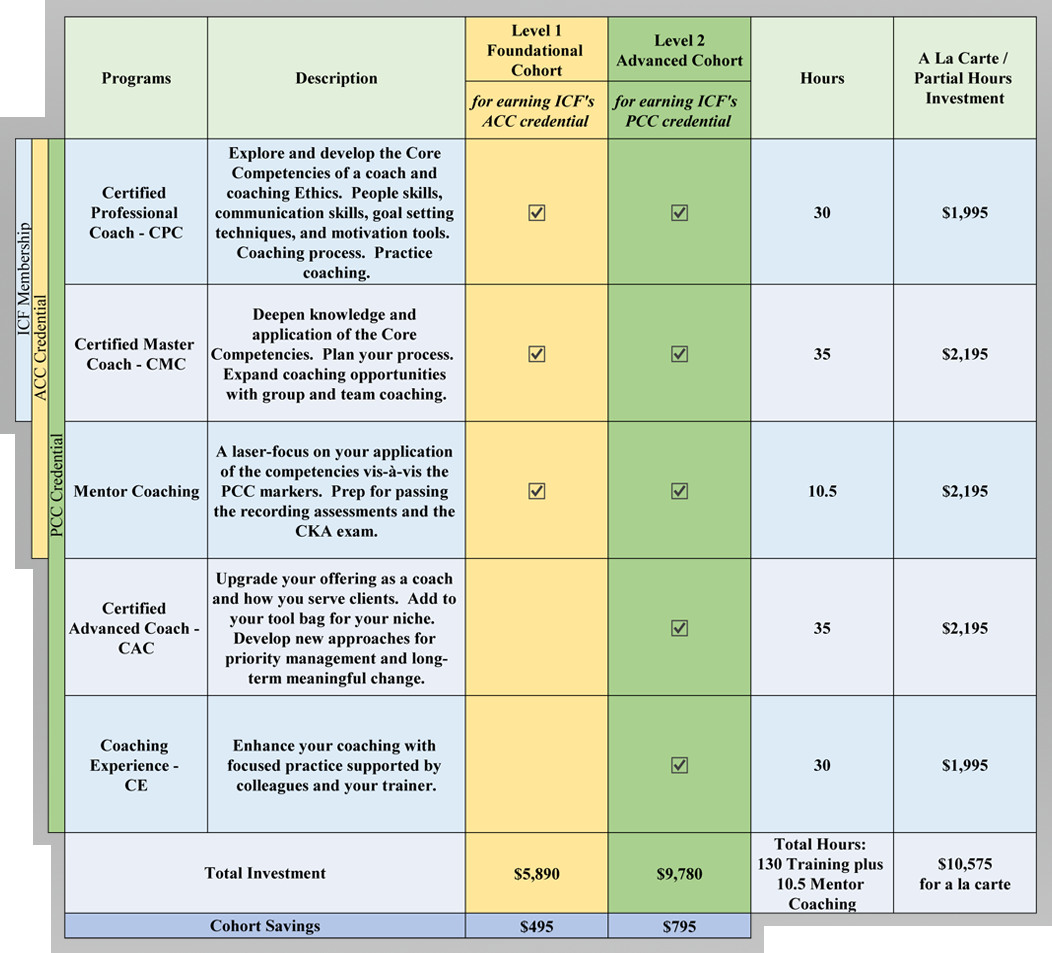
The left column in this chart lists the programs that are offered a-la-carte and the columns show them bundled in the Foundational or Advanced cohorts to save money and for earning an ICF credential: