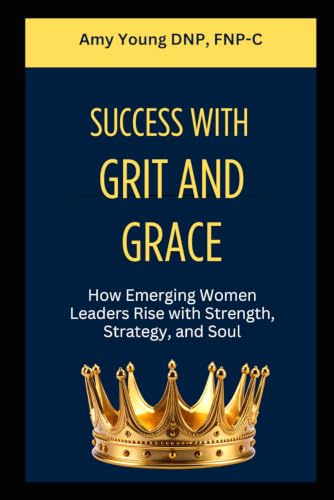
 Book Review of Success with Grit and Grace: How Emerging Women Leaders Rise with Strength, Strategy, and Soul by Amy Young, DNP, FNP-C
In this empowering and highly practical guide designed to help women navigate, negotiate, and redefine modern workplace leadership. Moving away from rigid, traditional, command-and-control structures, Young argues that the future of work is being transformed by inclusive, human-centered leadership models—and that women are uniquely positioned to pioneer this shift.
The Core Philosophy: Grit and Grace
The book’s central premise is that women’s leadership is uniquely forged in dualities. Rather than instructing women to “lean in” harder or copy historically dominant, masculine executive styles, Young advocates for building a leadership identity rooted deeply in who they already are.
- Grit is defined as the resilience, courage, and determination to keep going, even when navigating systems that were never originally designed with women in mind.
- Grace is the capacity to stay grounded, leading with empathy, authenticity, and humanity, which builds deep, lasting connection.
Together, these form a uniquely powerful leadership model.
Key Analytical Themes
- Naming the Double Binds and Invisible Rules
Young provides a clear-eyed analysis of the subtle, systemic friction women experience in the workplace, emphasizing that naming these barriers is the first step to dismantling them:
- The Double Bind: Women frequently navigate contradictory expectations, such as the Likability vs. Authority Trap(where asserting authority risks being labeled “abrasive,” but softening risks being dismissed as “not leadership material”) and the Competence vs. Warmth Dilemma.
- The Invisible Rules: Women routinely absorb unwritten, conflicting rules, such as being told to “be confident, but not too confident” or to “speak up, but don’t be aggressive”.
- Performance and Feedback Bias: The book highlights that men are frequently judged on potential, while women are judged strictly on proof. Furthermore, women tend to receive subjective, personality-based feedback (“you need to smile more”) that keeps them small, while men receive skill-based, actionable feedback that helps them grow.
- Redefining “Soft Skills” as Strategic Assets
A major strength of Young’s framework is how she reframes qualities historically marginalized as “soft” into critical business advantages:
- Empathy as Strategic Intelligence: This is not about absorbing others’ emotions, but utilizing relational intelligence to read subtle cues, build trust, anticipate downstream conflicts, and understand team motivation.
- Collaborative Decision-Making: Far from being a sign of indecision, leading collaboratively is shown to increase data access, build psychological safety, encourage innovation, and reduce systemic bias.
- Systems Thinking and Holistic Risk Assessment: Young shows how women excel at assessing risks comprehensively (prioritizing long-term consequence and cultural dynamics over short-term urgency) and seeing the broader ripple effects of executive decisions.
- Actionable Mindset Shifts and the Leadership Toolkit
The book is heavily practice-oriented, challenging women to transform their inner landscape so they can confidently step into their power.
- Perfectionism to Progress: Young notes that men routinely rise through imperfect action, while women often wait for perfect readiness. She encourages women to embrace action and iteration as part of growth.
- Communication Mastery: The book identifies how social conditioning leads women to use qualifying, minimizing language (e.g., “I might be wrong, but…” or “Sorry, can I add something?”) and provides concrete strategies to speak in headlines, remove unnecessary apologies, and use declarative language.
- Boundaries and Rest as Strategy: Redefining boundaries as essential guardrails rather than barriers, Young asserts that rest is not an indulgent reward for productivity, but the cognitive and strategic foundation of leadership longevity.
Usability and Structure
Young’s background as a leadership coach and practitioner shines in the book’s highly interactive and actionable formatting. Each chapter contains:
- Practical Scripts: Showing readers exactly how to manage up, address conflict clearly, set firm boundaries, and negotiate compensation using data-driven, assertive language.
- Real-World Case Studies: Honest, imperfect stories of women finding their voice in early career, shifting their style mid-career, reclaiming ambition after maternity leave, and navigating political executive dynamics.
- Reflection Prompts and Audits: Interactive exercises to help readers inventory their strengths, map their personal influence networks, and write their own “Leadership Manifesto”. A companion workbook is also included in the appendix to facilitate this work.
Critical Conclusion
Success with Grit and Grace is a timely, sophisticated, and deeply human handbook for emerging women leaders. By focusing on alignment over imitation, Young successfully reframes the leadership conversation, proving that women are better off being who they are to succeed, and must become more of who they already are to change workplaces for the better.